
Why Reach?
This collection of spiritual innovation vignettes focuses on those projects and communities that have been able to scale their work—by which we mean they have made their offerings widely available, found resonance with a target audience, and affected a contextually significant number of people. Without positing that larger projects are better than smaller ones, and remembering that “scaling” depends on the local constraints, we do lift up those projects that have affected significant numbers of people as one measure of successful spiritual innovation. If our premise is that there are unmet spiritual needs, then projects that reach people with those spiritual needs are worth lifting up. This is not to deny the value of small, localized projects—but merely to point to the large scale of spiritual seeking in a time of institutional upheaval.
Reach is a foundational question for many spiritual innovators. Is scaling possible? Is it wise? Many spiritual innovators feel caught between the potential impact of scaling up and the equal potential to lose depth when focusing on breadth. Just as importantly, in a funding landscape that celebrates scale, spiritual innovators feel the pressure to illustrate growth as a sign of success.
The following four vignettes feature a variety of scaling models. Each organization has grappled with the question of reach, succeeding in spreading their work without losing the core impact they seek to make.

1. Jagriti Yatra

What is it?
Jagriti Yatra is a 15-day, 8000-km train journey to inspire Indian youth to become entrepreneurs. Chief Executive Officer Ashutosh Kumar explains that its philosophy and design draw on spiritual principles—Jagriti Yatra intentionally learns from the ancient tradition of pilgrimage in India, recognizing that both inner and outer journeys are necessary to facilitate transformation.
Indeed, the program is designed to support the spiritual well-being of a generation often looking for something beyond themselves. Spiritual practices pepper the experience, from daily moments of silence, to small group reflection with mentors, to meditating and chanting around a 300-year-old Banyan tree, to a winter night sleeping without heat in a village in solidarity with the majority of Indians who live this way. When the ride is over, participants celebrate with a valedictory session where they get to express their growth through art and music. This rite of passage marks them with a new identity: they are Yatris now.
Despite these rich spiritual roots, Jagriti Yatra posits itself as a secular program with a nation-building goal. Any intertwinement between nationhood and spirituality connotes a political project, and this merits further study.
Where does it demonstrate excellence in reach?
Founded in 2008, Jagriti Yatra—which translates to Journey of Awakening—has over 8,000 alumni who have shared the transformative pilgrimage-like program. Each journey brings together 500 aspiring entrepreneurs, selected from over 20,000 applicants. Twenty-eight percent have gone on to start their own ventures, almost 60% of those in rural communities, and many more stay in frequent touch with their fellow Yatris.
Although the option of creating more train journeys around India exists, Jagriti Yatra’s CEO Ashutosh Kumar explained in an interview with us why he wasn’t pursuing this mode of scaling. “What we realized is that we don't need to scale up our product or service. Because that is not why we started this whole journey. The journey, the train journey, is merely a tool for us. So anybody coming from this Western lens would have told us, why don't you do two journeys, three journeys, four journeys in a year, so that you cater to more people? But we instantly felt, no, that is not the right way to do it.” Instead Kumar focused on the core of Jagriti Yatra’s impact: inspiration and connection. Instead of adding more train journeys, they’ve developed programs for the alumni of the journeys—to support their entrepreneurship and activity, especially in rural areas.
What stands out in their approach to scaling?
This engagement with alumni after the core experience stands out in Jagriti Yatra’s approach. Kumar and his team are working to establish hubs throughout India to foster ongoing collaboration and community among Yatris. They have started in Uttar Pradesh, building a support ecosystem that provides community, mentorship, and access to resources for all Yatris who come and stay, as they continue to try and foster entrepreneurship in rural areas. This vision is rooted in the concept of ‘kṣetra-sannyāsa’ in Hindu tradition, in which one leaves behind a former life and goes to be in a place of energy or grace.
Where do they struggle in their approach to scale?
While Jagitri Yatra's approach to alumni-based scaling has proven central to their reach, their model has proven difficult to replicate. In the US, Jagitri Yatra inspired the Millennial Trains Project, while in the UK it inspired Drivers for Change—but none of these organizations have been as long-lasting or successful in scaling as the home project in India.
2. Insight Timer

What is it?
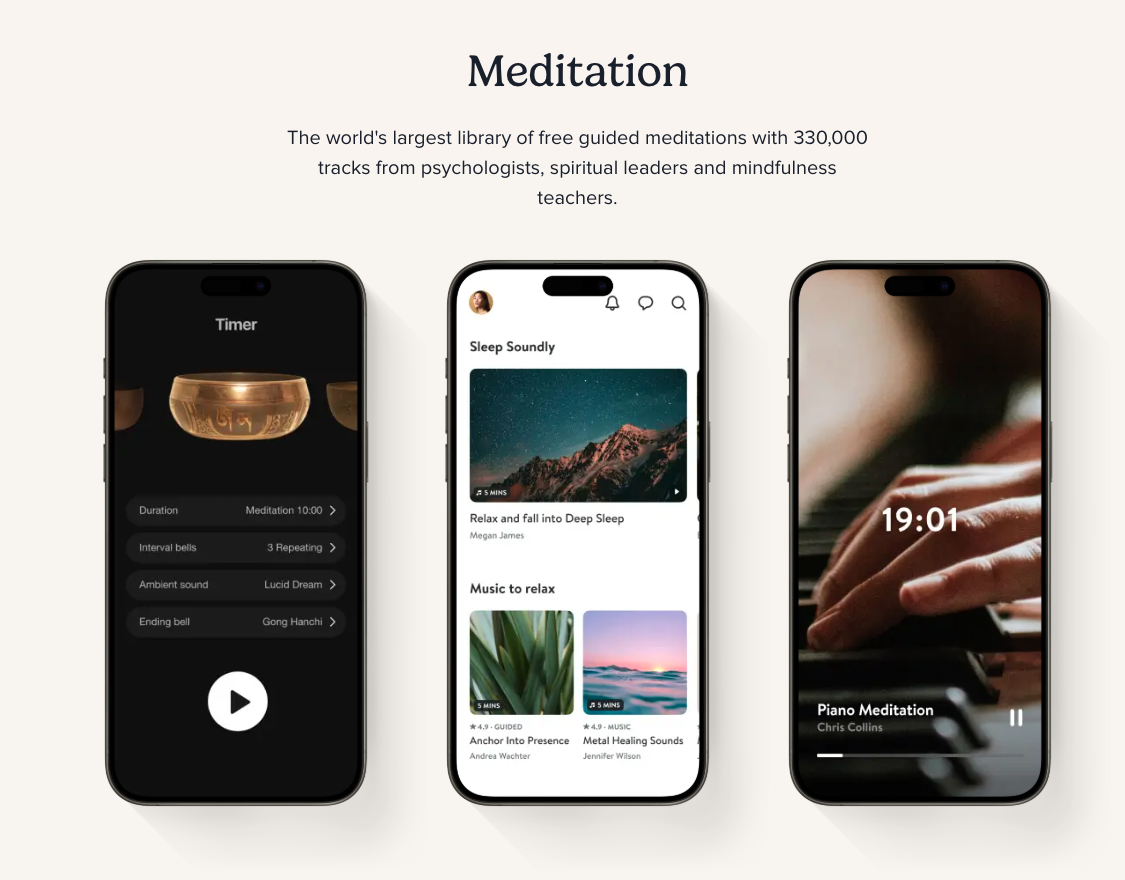
Insight Timer is a meditation app and platform, with 10,000 people signing up every single day. From humble beginnings as a simple timed bell to signal the end of a meditation session, Insight Timer has grown into a platform with thousands of teachers, a wide variety of paid wellness content, and a digital community of 3 million monthly active users around the world.
Where does it demonstrate excellence in reach?
Competing in a landscape with other players like Headspace and Calm, who’ve received far more venture capital investment, Insight Timer has developed a platform with a two-sided marketplace model. On one side, users access meditation content ranging from 30-second sound bites to 90-minute deep dives. On the other side, over 20,000 teachers upload content, build followings, and generate income through the platform’s various monetization mechanisms. Questions remain to be asked about the nature of this work and how it affects the spiritual content delivered on the platform. This has cultivated an ecosystem with network effects where more content attracts more users, which in turn attracts more creators—all the while generating enough revenue to keep the platform running.
What stands out in their approach to scaling?
Focusing on the content and cultivating the user community has meant that Insight Timer has not spent any budget on advertising. All of its growth has been through word of mouth.
Where do they struggle in their approach to scale?
Because Insight Timer is privately owned and has taken venture capital money, the pressure to grow is constant. Recent integrations of AI tools and teachers upselling users with offerings like retreats has meant that many long-standing users decry the changes on the app and wish for a return to the days of a simple tool for timing meditations.
3. Center for Action & Contemplation

What is it?
Founded in 1987 by the Franciscan friar and author Richard Rohr, the Center for Action and Contemplation offers programs and resources that introduce wisdom from the Christian contemplative tradition to a contemporary audience. Rohr has been at the periphery of his Catholic tradition for some time—deeply rooted but radically open to new thinkers like Ken Wilber, fusing ancient theology with contemporary psychology. Also worthy of note has been the CAC’s embrace of new technologies—being one of the first Christian institutions to embrace widespread digital programming, such as its Living School program.
Today, through teachings, practices, or community engagement—mostly shared online—the CAC’s goal is to help people live out this wisdom in practical ways, so that they become instruments of love, peacemaking, and positive change in the world.

Where does it demonstrate excellence in reach?
With over one million subscribers to the Daily Meditations newsletter, and tens of thousands of alumni from their two-year program the Living School, the CAC has become a meaningful source of Christian contemplative wisdom and a hub of community for those seeking depth in the Christian tradition who may struggle to find it through their local congregation.
What stands out in their approach to scaling?
Built on the writing and teachings of their founder, the CAC has spent more than a decade preparing for the transition from being a founder-led institution to becoming a center for contemplative Christianity reaching far beyond Rohr’s work alone. Through the integration of other voices in the Daily Meditation emails, the recruiting of a core faculty to lead in-person and digital programming, and the transition of Father Richard out of any organizational leadership roles before his death, the CAC has navigated this challenge while maintaining, and even growing, its reach.
Where do they struggle in their approach to scale?
Despite deep commitment to diversifying its teaching faculty and featured writers, the CAC’s core audience remains far whiter than the average American. In effect, although their numbers have grown significantly over the last nearly 40 years, their audience demographics have remained more or less the same.
4. Judaism Unbound

What is it?
Judaism Unbound is an online center for education serving as a catalyst for a new era of Judaism. Its mission is to empower regular Jews who are disenchanted with, or disconnected from, mainstream Jewish institutions to develop new ways of living Jewishly. Primarily through podcasts and digital programming like the UnYeshiva, Judaism Unbound presents innovative thinkers and practitioners as well as practical workshops to help people create their own Jewish future.

Where does it demonstrate excellence in reach?
During the pandemic, Judaism Unbound was able to rapidly pivot and create jewishLIVE, which combined a digital production studio and an online hub of live-streaming (and recorded) Jewish experiences, creating over 1,000 hours of innovative content from their own team and many partners. It invested in infrastructure that could then be used by tens of other organizations—a model it is now embracing in producing podcasts from up-and-coming Jewish voices. In particular, these efforts align with Judaism Unbound’s radical vision for a post-Rabbinic future of Judaism, in which knowledge and leadership is widely distributed, in some contrast with existing Jewish institutions that seek to continue pursuing excellence in congregational structures and leadership.
What stands out in their approach to scaling?
Judaism Unbound’s scale is not remarkable in its size—the number of listeners is modest compared to larger spiritual and religious podcasts, for example—but it has cultivated a clear and influential niche with a wide reach to Jewish innovators in the United States.
Where do they struggle in their approach to scale?
This strength of cultivating a niche audience also implies challenges of funding. Judaism Unbound is reliant on grants and does not yet have a self-sustaining community. Whether philanthropic sources will continue to support the content Judaism Unbound creates will have to be seen.
Reflections on Spiritual Innovation and Reach
Taken together, these four vignettes resist easy conclusions. Attempts to reach scale are a constant negotiation—one that each organization navigates with its audience, its funders, and its own values. Jagriti Yatra chose depth and measured growth over rapid scaling. Insight Timer chose platform growth and is paying a price in trust. The CAC has sought diversity as well as scale, but has struggled. And Judaism Unbound chose niche influence as its desired scale. None of these trade-offs are failures; each of these spiritual innovation organizations has had success, even if they have to navigate a complicated context.
Further Reading
Ammerman, Nancy T. “Rethinking Religion: Toward a Practice Approach.” American Journal of Sociology 126, no. 1 (2020): 6–51. https://doi.org/10.1086/709779.
Bender, Courtney. The New Metaphysicals: Spirituality and the American Religious Imagination. University of Chicago Press, 2019.
Bowler, Kate. Blessed: A History of the American Prosperity Gospel. Oxford University Press, 2013.
Braunstein, Ruth, Jaime Kucinskas, Brian Steensland, and Daniel Winchester. “Religion Unbundled: Toward a Twenty-first Century Paradigm for the Sociology of American Religion”. SocArXiv, August 15, 2025. doi:10.31235/osf.io/jr6fu_v1.
Cadge, Wendy. “Afterword: The Spiritual Infrastructure of the Future.” In Redefining Spiritual Spaces in the Age of Technology: Innovations and Pitfalls, edited by Stacey K. Guenther, Xiaoan Li, and Michelle A. Scheidt. Springer Nature Switzerland, 2025. https://doi.org/10.1007/978-3-031-93436-0_13.
Chen, Carolyn. Work Pray Code : When Work Becomes Religion in Silicon Valley. 2022, 1–272.
Martí, Gerardo. “New Concepts for New Dynamics: Generating Theory for the Study of Religious Innovation and Social Change.” Journal for the Scientific Study of Religion 56, no. 1 (2017): 6–18. https://doi.org/10.1111/jssr.12325.
Mulder, Mark T., and Gerardo Martí. The Glass Church: Robert H. Schuller, the Crystal Cathedral, and the Strain of Megachurch Ministry. Rutgers University Press, 2020. https://doi.org/10.36019/9780813589084.
Steensland, Brian, Jaime Kucinskas, and Anna Sun. Situating Spirituality: Context, Practice, and Power. Oxford University Press, 2021.
Stewart, Evan, and Jaime Kucinskas. Scheduling Secularity? Work Scheduling and Self-Reported Religious and Spiritual Participation. December 10, 2025. https://osf.io/k59eb.
Sutcliffe, Steven J., and Ingvild Saelid Gilhus. New Age Spirituality: Rethinking Religion. Routledge, 2014.
Watts, Galen. The Spiritual Turn: The Religion of the Heart and the Making of Romantic Liberal Modernity. Oxford University Press, 2022.