
Why Effectiveness?
This collection of vignettes focuses on those projects and communities that are particularly effective as spiritual innovations—by which we mean they are:
- impactful in helping people flourish and contribute to the greater good;
- engaging participants successfully;
- addressing spiritual longings in particularly relevant and compelling ways.
In sharing these vignettes, we seek to highlight projects that achieve excellence in at least one of those arenas of content, engagement, and impact.
1. American Revival
What is it?
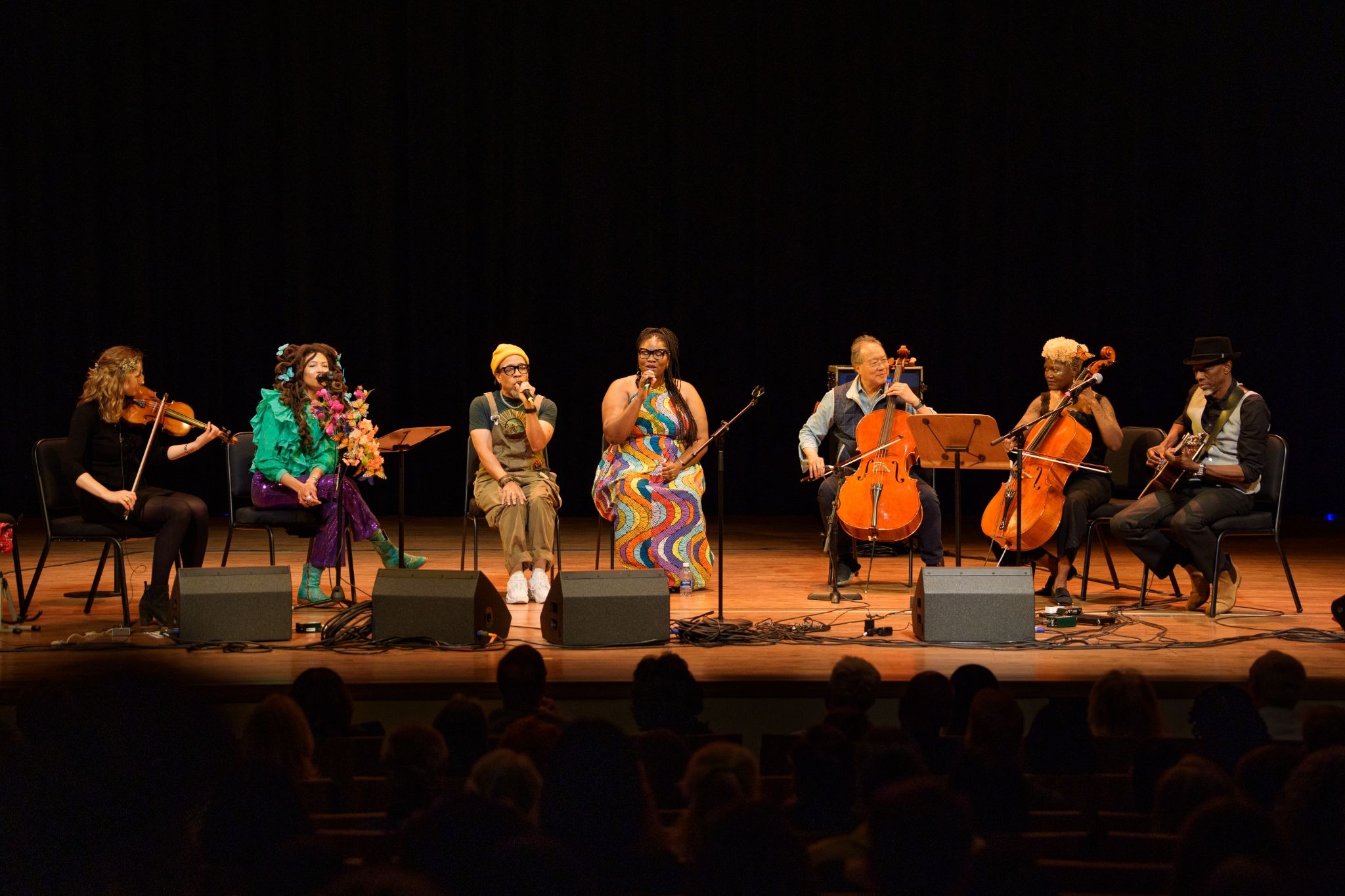
American Revival is a traveling festival of hope and connection, inspired by the tradition of religious revivals. Created by filmmaker Nicholas Ma, American Revival brings people together across political, cultural, and spiritual divides, through a powerful three-day experience.
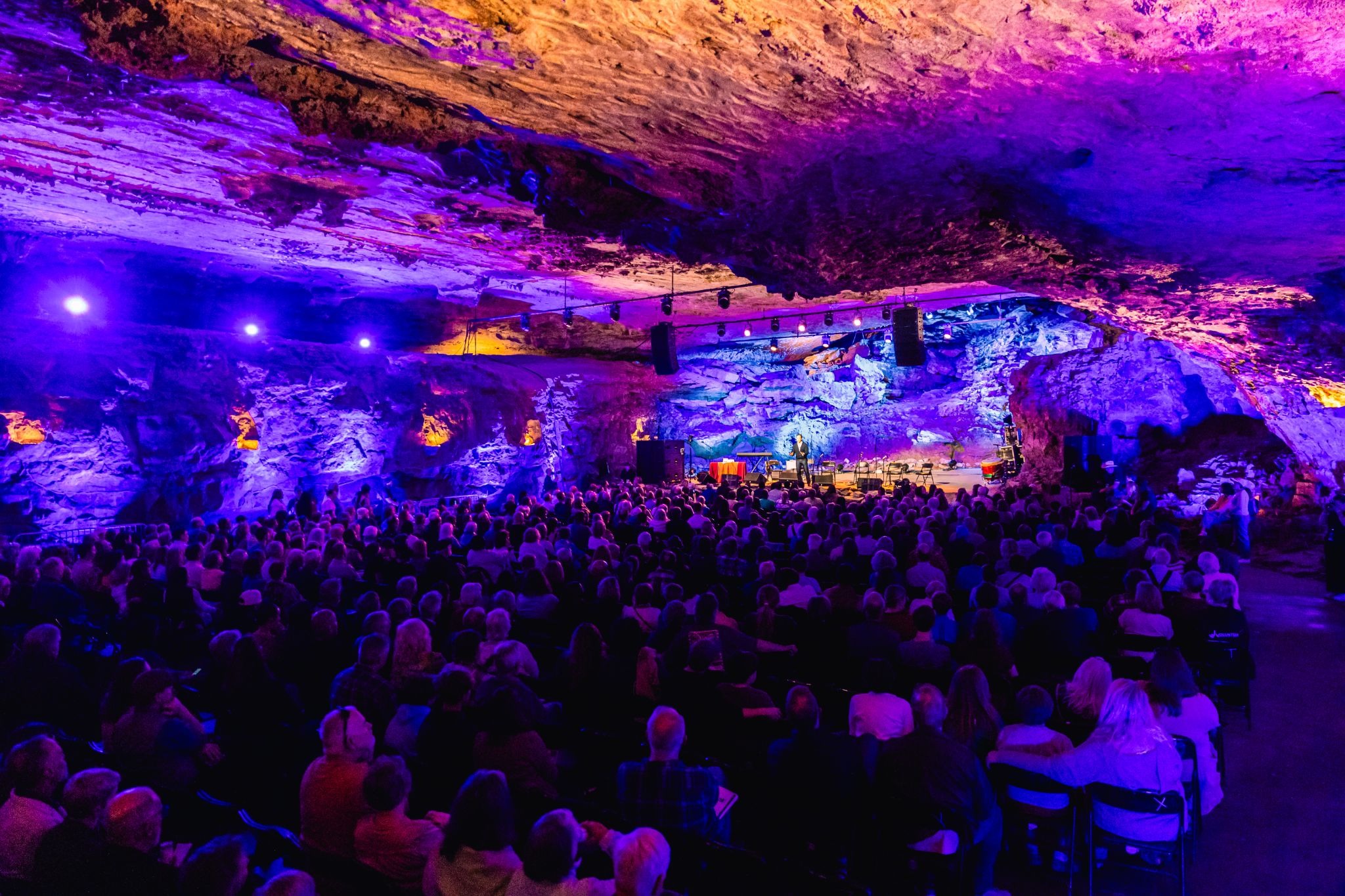
Each stop on the tour is uniquely tailored to its host city, but every Revival shares one purpose: to move people from curiosity about their community to commitment to improving it, through purpose, relationships, and service. Featuring artists like Yo-Yo Ma, Valerie June, Alfre Woodard, and leading minds from science and faith, each Revival blends art, storytelling, dialogue, and hands-on volunteering to forge lasting bridges across difference. To date, American Revival has come to cities like Bentonville, AR, Salt Lake City, UT, and Montgomery, AL and more rural areas like Grundy County, TN and Cape Cod, MA.
Working with tens of local partners spanning religious and political divides, American Revival casts a vision for a unifying event, brings in high-profile guests, and convenes neighbors from across a city or rural area who would otherwise never seek one another out—indeed, who might actively distrust one another. Through the artistic, reflective, and spiritual experience of the Revival, the organizers are able to cultivate an event in which those who are wary of one another find an openheartedness and even a sense of unity.
Where does it demonstrate excellence in content, engagement, and impact?
In an interview with Sacred Design Lab, co-founder Nicholas Ma explained the first principle for deciding where to host the next American Revival: “We go only where we’re invited. If we don’t have someone who’s willing to champion the work, we won’t go.” That local partnership comes in all shapes and sizes—they’ve been invited to different sites by a local faith leader, an activist group, and a philanthropist. “What matters is that it is someone who is beloved in the community who thinks, ‘my town needs this and I can introduce you to fifty people who agree with me!’” says Ma.
Second, the engagement strategy is enormously responsive to local context. Rather than coming into town with a pre-packaged, expertly produced experience, American Revival changes dramatically every time the organizers put it together. “Being so open means having to be okay with it not being the thing you thought it would be,” says Ma. “We invite at least one hundred local organizations to meet with us as we prepare. And those conversations are often a mix of suspicion and enthusiasm. You can’t say here’s our tried and true plan—that doesn’t work.” From those conversations the program emerges—and because local partners see themselves in the program, they’re invested in the project and help bring out their constituents or members. Ma puts it like this: “If these people aren’t bought in, they won’t show!”
What stands out in their approach to content, engagement, and impact?
American Revival has cultivated a powerful experience that leaves lasting impact. But instead of offering an entertainment experience alone, the team has multiple opportunities that lead to lasting engagement. These span from the personal—asking everyone to reflect privately by writing on a postcard the three people they want to love better—and the organizational. On day two, American Revival hosts a Festival of Helpers, a volunteer festival where a third of the audience returns to learn about local organizations where they might offer their time and skills. This means hundreds of new volunteers for local projects. Not only that, but the by-product of all these local non-profits gathering together means that they also meet one another and find connections that otherwise would not have been made.
“It’s about developing an ecosystem,” explains Ma. “The Festival of Helpers is both an opportunity for people to sign up to volunteer, but it also puts gas in the tank of the organizations to remember that they are not alone. There isn’t usually a reason for the foodbank and the music-in-schools organization to be in touch, but when you bring them together, it changes the sense of shared mission. It even serves their spiritual lives because it buoys people.” This virtuous cycle in which helpers see helpers leaves everyone feeling more hopeful and more connected.
American Revival’s great insight is that an outside invitation can bring local organizations together in ways a local convener would struggle. New partnerships can emerge. New stories can, too. In Grundy County, TN, for example, where the predominant story is one of deprivation, American Revival insisted on telling a different story. “We got to show Grundy County as a place where there is a ton of opportunity and skill—to make visible the gifts of the place and then letting people come to their own conclusion,” explains Ma.
Where do they struggle in their approach to content, engagement, and impact?
Putting on an American revival is intensive; both in terms of time and money, but also explains Ma, in terms of faith. “You have to choose to believe in it. As the organizers, we have to demonstrate faith that the right venue will present itself, that there’ll be volunteer drivers, and hosts, and everything else that it takes to make these festivals happen.” By leading with that commitment and hope, Ma and his team have repeatedly found it is matched in return from local leaders—and more. “All of that is especially difficult in places where people have felt let down by outsiders before. Keeping that faith is the real work!”
This intensity of philanthropic resources and personal commitment means that the project is difficult to replicate. The team’s personal network of top-tier musicians and other artists and speakers, whom they can invite to show up in unusual places around the country, also makes this project unique.
2. Center DC

What is it?
Since 2015, Center DC has hosted faith-based gatherings that help people practice and explore Islam. As a non-sectarian community, Center DC seeks to serve Muslims from a wide variety of theological convictions with relevant, thoughtful education that focuses on strengthening community bonds. Nearly entirely financed by the community itself, Center DC opened its doors to a permanent home in the District in 2023—a testament to the long-term engagement the Center has built with its members.
Center DC’s strategy of relationship-building is anchored in the prophetic model of one-to-one connections, and has been especially impactful for those who have grown distant from their Muslim faith or the Muslim community.
Where does it demonstrate excellence in content, engagement, and impact?
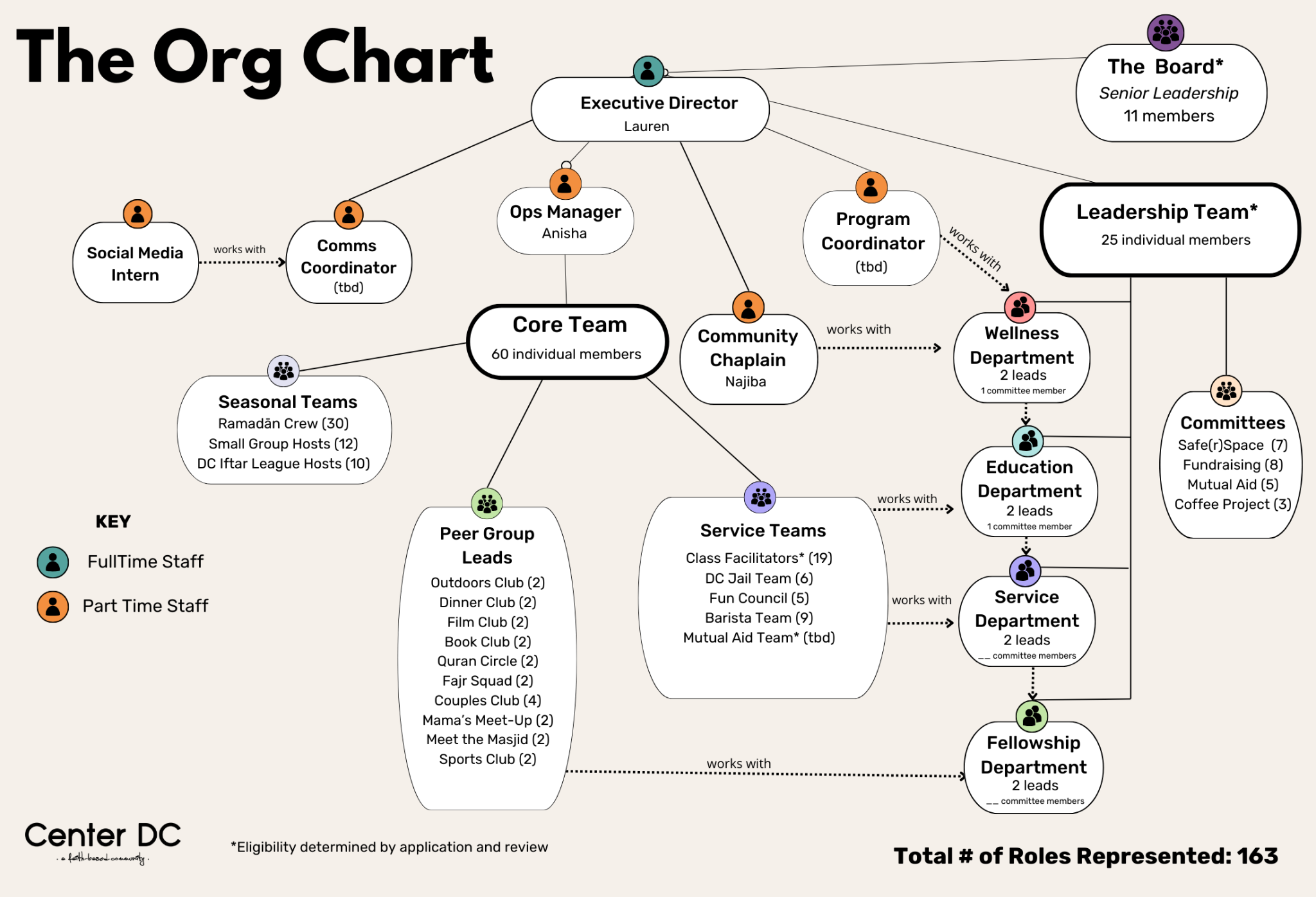
Both because the budget is lean and because the purpose of the Center is to grow relationships, the team has designed a structure that necessitates over one hundred leadership roles for volunteers. Center DC has only one and half full-time staff members. The rest of the work is all volunteer-led.
This means that the Center has a thoughtful and well-practiced model of designing for limited-capacity leadership. Leadership roles require a twelve-month commitment while other volunteers can offer support for a season of 3-6 months; long enough for people to make a meaningful contribution, but small enough to not be too intimidating when potential volunteers are invited to step up. For these seasonal roles (like being part of the Ramadan Crew or Small Group Hosting team), volunteers are trained once a quarter. But for leadership roles, new cohorts are welcomed twice a year. This maximizes efficiency and gives new leaders the experience of being part of a new cohort together.
In addition to their training, volunteers make a team pledge. This step requires them to state their intention of serving the community—and if roles change over the year, the pledge is taken again. This keeps the organization's mission and ethical commitments fresh in the minds of all volunteers—an essential communal glue when relying on a widely-spread team without formal contracts.
What stands out in their approach to content, engagement, and impact?
The close engagement of volunteers means that Center DC has an extraordinary ratio of events to staff. In 2025, the Center hosted 622 gatherings, engaging nearly 2,453 individuals, with 46% of those attending more than one event a month. The core constituency is young people in their 20s-40s. Seventy-one percent of those described Center DC as the primary faith community—making this a vibrant congregation for a generation of Muslims in the Washington, DC area that might otherwise not have a faith community to call home.
Separately, and as these statistics themselves reveal, Center DC has a strong focus on capturing and tracking data to understand their impact. In 2020, for example, thanks to six volunteer listeners who completed more than 50 one-on-one community conversations, the Center was able to have a clear understanding of what it could offer to its constituency in the middle of the pandemic. Rigorous tracking of programs and events means that the Center can focus its efforts on those that are most valuable to participants.
Where do they struggle in their approach to content, engagement, and impact?
With a distributed leadership model, there’s always a challenge of maintaining standards of ethical action and skillful facilitation. Center DC works hard to implement its Safe(r) Spaces policy, and repeatedly reaffirms its Community Agreements to try and embed these across all gatherings. But, inevitably, sometimes these fall short.
As the first generation of participants and co-creators mature into a life-stage with children, aging parents, and other new challenges, the Center will have to navigate whether to grow with these members into offering new programs and services (for example, their offering to match Muslim nannies with Muslim families), or whether to keep their programs focused on younger people who are in an earlier stage of life.
3. Uplift Kids
What is it?
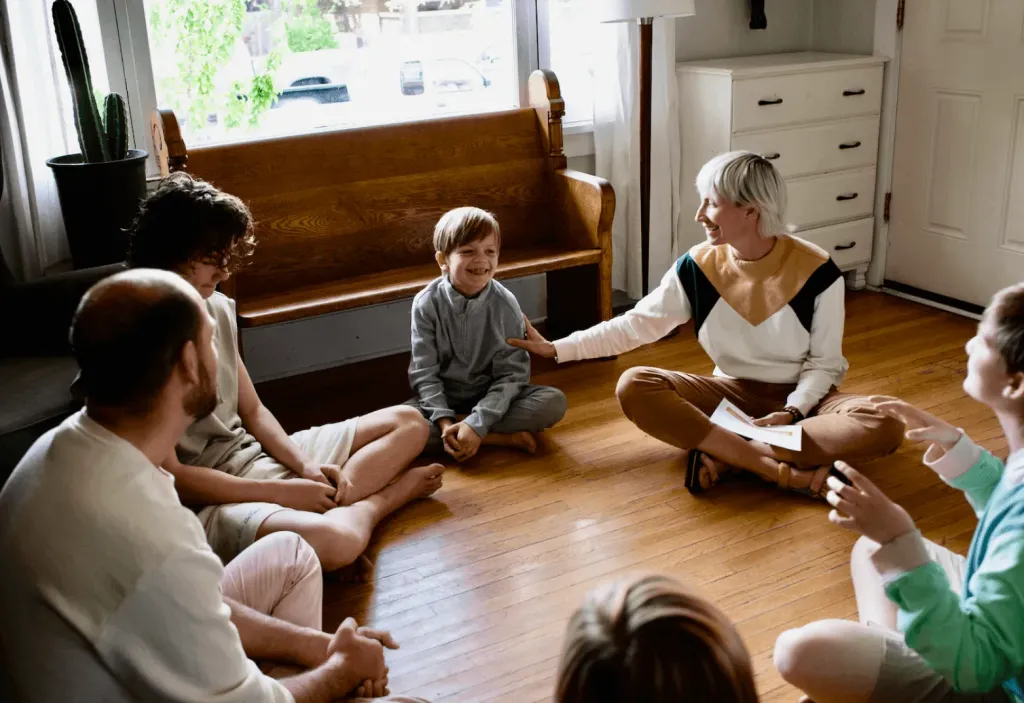
Uplift Kids is designed to help parents and children find their inner compasses. Providing digital resources to explore an expansive spirituality, the subscription-based service offers lesson plans, videos, and other content that helps families construct a moral foundation that they may find lacking outside of a religious congregation. Founded by a group of former members of the Church of Jesus Christ of Latter-day Saints, Uplift Kids’ content aims to integrate modern science and ancient wisdom, including stories and traditions that may be meaningful to those familiar with Mormonism and Christianity. The language is intentionally spacious, using, for example, “conscience, spirit, source, the true self, or the divine” as potential names for what each family might want to describe as that which has ultimate meaning.
Where does it demonstrate excellence in content, engagement and impact?
Building a steward-owned business that employs three full-time employees in addition to various contractors is evidence enough of both the demand for this type of content for young families, and the excellent service that Uplift Kids provides. For many Millennials who left the church with hurt or distrust, or who simply are searching for an intentional approach to their parenting outside of a religious institution, Uplift Kids provides excellent content to structure a weekly small gathering for families and rituals at mealtime or bedtime. They also offer conversation starters and suggest language that empowers parents to talk about values, morality, and spirituality—especially when parents may feel unsure of their own spiritual commitments and beliefs.
What stands out in their approach to content, engagement, and impact?
Though it makes up a small percentage of Uplift Kids’ activities, the staff hosts an in-person community in Salt Lake City and runs a popular summer camp for families—evidence of the potential for integrating real-life community with digital content. The summer camp is designed along the same lines as the lesson plans and videos, focused on reflection, transformation, and spiritual growth for the whole family. Evidence of its impact is demonstrated by the fact that after booking opens, a significant majority of families from last year sign up for the next summer. Uplift Kids will host two summer camps in 2026—one in Utah and another in Oregon.
Where do they struggle in their approach to content, engagement, and impact?
The library of resources has grown significantly in the last few years—now including printable sheets with real-world scenarios for kids and their parents to work through, an app, and digests sharing insights from Lisa Miller’s work at Columbia University on the science of spirituality. Now, Uplift Kids needs to decide whether to focus on growing the content offering beyond their primary constituency of former LDS members and seek out a wider spiritual-but-not-religious or unaffiliated audience, or to go deeper with those they are already serving with more in-person activities, for example. Early experiments on the former have proved less effective, and so the question remains whether an approach that worked well with one audience resonates with a broader one.
4. Lab/Shul
What is it?
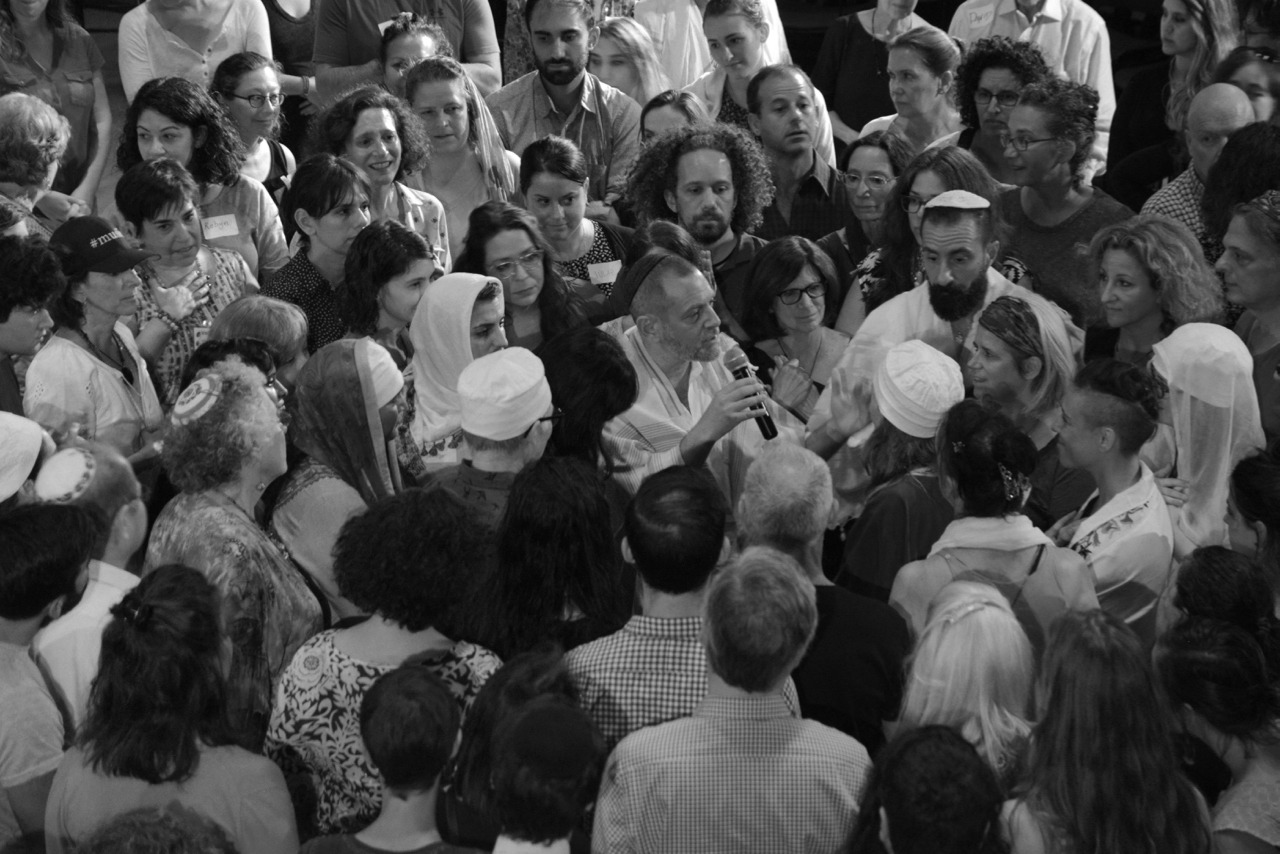
Lab/Shul describes itself as an “everybody-friendly, artist-driven, God-optional, experimental community for sacred Jewish gatherings based in NYC and reaching the world.” Since the beginning, Lab/Shul has attracted Jews who otherwise would not show up in a synagogue.
In 1999, founder Amichai Lau-Lavie, an Israeli educator and performance artist, created a Jewish ritual theater company that pioneered replicable models for the integration of Jewish education and the performing arts, which started to offer worship services that challenged traditional liturgical practices and centered creativity. From the mid-2000s, a more regular rhythm of Shabbat and Jewish holiday services were offered and a congregation formed, becoming Lab/Shul.
Today, Lab/Shul offers lifecycle rituals, a weekly Shabbat service, a digital mourners call, volunteering opportunities, family programming, and Jewish education—in short, many of the experiences one would expect to find in a synagogue. But, Lab/Shul describes itself as “pop-up by design,” still moving from one venue to another around Manhattan and Brooklyn.
Where does it demonstrate excellence in content, engagement, and impact?
Lab/Shul’s impact extends beyond its own creative programming; it also serves as a source of inspiration for countless other Jewish communities around the country—especially those who seek to break with some of the traditional models of synagogue life. Through the documentary Sabbath Queen, for example, Rabbi Lau-Lavie shares his story as both a rabbi and drag performer and illustrates how Lab/Shul celebrates important moments in the Jewish calendar in creative ways. There are Zen Shabbat services and queer Torah study sessions through the “Below the Bible Belt” series, for example, as well as the community’s consistent commitment to being “God-optional.”
What stands out in their approach to content, engagement, and impact?
Lab/Shul has never sought to be housed in one building. This has resulted in a lot of logistical work over the years—but has offered an opportunity to move around venues in New York City, as well as finding creative and visually striking homes for ritual experiences that otherwise would always be hosted in the same space. Depending on other spaces has also facilitated greater connection to other faith communities and creative institutions. Lab/Shul’s leadership team has long emphasized interfaith work, on justice issues and collective service opportunities, and also using these relationships to make known that the community welcomes those who are Jewish, Jew-ish, or who love someone in the community but aren’t Jewish themselves.
Where do they struggle in their approach to content, engagement, and impact?
With such a charismatic founder at the helm of the project for more than two decades, the recent announcement from Rabbi Lau-Lavie that he was transitioning out of his role leaves big shoes to fill. Will the community look for another charismatic rabbinic leader with a similar artistic flair? Or will the board seek to strengthen other parts of the organization, and perhaps settle into a more formal community that looks increasingly like other synagogues? It may be that the period of cultural disruption has been completed and what now best serves the community is steadfastness and institution-building. But because Lab/Shul has always seen itself as a laboratory, long-term stability may not be what is most important for it to strive for within the larger Jewish community.
Further Reading
Ali, Tazeen M. The Women’s Mosque of America: Authority and Community in US Islam. 1st ed. NYU Press Scholarship Online. University Press, 2023. https://doi.org/10.18574/nyu/9781479811311.001.0001.
Avishai, Orit. Queer Judaism: LGBT Activism and the Remaking of Jewish Orthodoxy in Israel. NYU Press, 2023. https://nyupress.org/9781479810031/queer-judaism/.
Bullivant, Stephen. Nonverts: The Making of Ex-Christian America. Oxford University Press, 2022. https://doi.org/10.1093/oso/9780197587447.001.0001.
Haddad, Yvonne Yazbeck. Becoming American? The Forging of Arab and Muslim Identity in Pluralist America. 1st ed. Baylor University Press, 2011. https://www.baylorpress.com/9781481319287/becoming-american/.
Hoffman, Warren, and Miriam Steinberg-Egeth. Warm and Welcoming: How the Jewish Community Can Become Truly Diverse and Inclusive in the 21st Century. Rowman & Littlefield Publishing Group, 2022. https://www.jewishbookcouncil.org/book/warm-and-welcoming-how-the-jewish-community-can-become-truly-diverse-and-inclusive-in-the-21st.
Miller, Lisa. The Awakened Brain: The New Science of Spirituality and Our Quest for an Inspired Life. Random House Publishing Group, 2021. https://www.penguinrandomhouse.com/books/608347/the-awakened-brain-by-lisa-miller-phd/.
Patel, Eboo. Interfaith Leadership: A Primer. Beacon Press, 2016. https://www.beacon.org/Interfaith-Leadership-P1222.aspx.
Pittinsky, Todd L. Crossing the Divide: Intergroup Leadership in a World of Difference. Leadership for the Common Good. Harvard Business Press, 2009. https://mitpressbookstore.mit.edu/book/9781422118344.
Schmidt, Leigh Eric. Restless Souls: The Making of American Spirituality. University of California Press, 2012. https://www.ucpress.edu/books/restless-souls/paper.
Webb, Jon R. Handbook of Spirituality, Health, and Well-Being: A Psychological Perspective. Taylor & Francis, 2025. https://www.routledge.com/Handbook-of-Spirituality-Health-and-Well-Being-A-Psychological-Perspective/Webb/p/book/9781032575902.